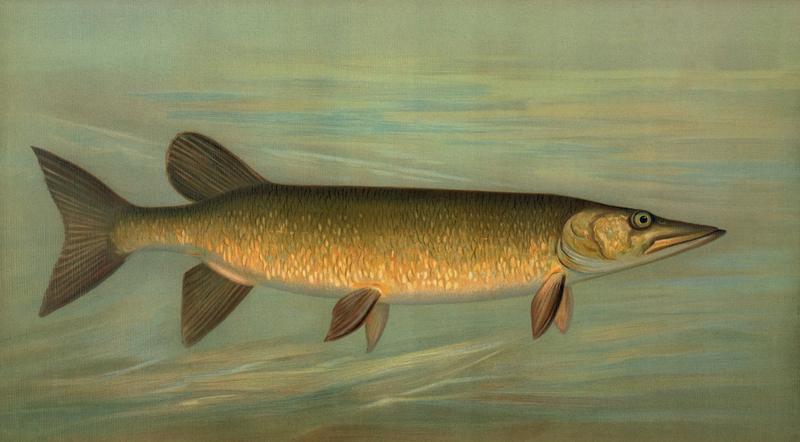
A tiger musky is a cross between a muskellunge and a northern pike. It looks like a musky with bold tiger stripes, and it fights like one too. But it's a hybrid, and it can't reproduce. In New York, nearly all of them come from a hatchery.
Musky, tiger musky, and pike are all cousins in the pike family. They're long, toothy hunters with a duck-bill snout. That makes them easy to mix up, so here's how to tell which one you just caught.
What is a tiger musky?
The tiger musky, or tiger muskellunge, is a hybrid. Most come from crossing a female musky with a male northern pike. The result is a fish that grows fast and hits hard.
New York's Department of Environmental Conservation (DEC) calls it a sterile, fast-growing cross. Since tigers can't spawn, the only way to keep them in a lake is to stock them. DEC has stocked tiger musky since 1968. Today it stocks them in about 35 waters, mostly in central and northern New York. DEC calls Otisco Lake perhaps the state's top tiger musky lake. Closer to Alexandria Bay, DEC stocks tigers in Hyde Lake, in the town of Theresa in Jefferson County.
Tigers grow faster than true musky, but they don't get as big.
How do you tell a tiger musky from a musky?
Start with the markings, then check the tail.
- Markings. Both fish have dark markings on a light body. A true musky usually has dark vertical bars or spots, and some have almost no marks at all. A tiger's bars tend to be bold, broken, and wavy, like tiger stripes.
- Tail. This is the best quick clue. A true musky's tail lobes come to sharper points. A tiger musky's tail lobes are rounded, like a pike's.
- Jaw pores. Under the lower jaw are small holes called sensory pores. Fish use them to feel movement in the water. A true musky has 6 or more on each side. Tigers can land anywhere in between musky and pike, so the pore count isn't a reliable test for a hybrid.
If the fish has musky-style dark bars but a rounded tail, there's a good chance it's a tiger.
How do you tell a musky from a northern pike?
This one is easier, and the pore count is the classic test.
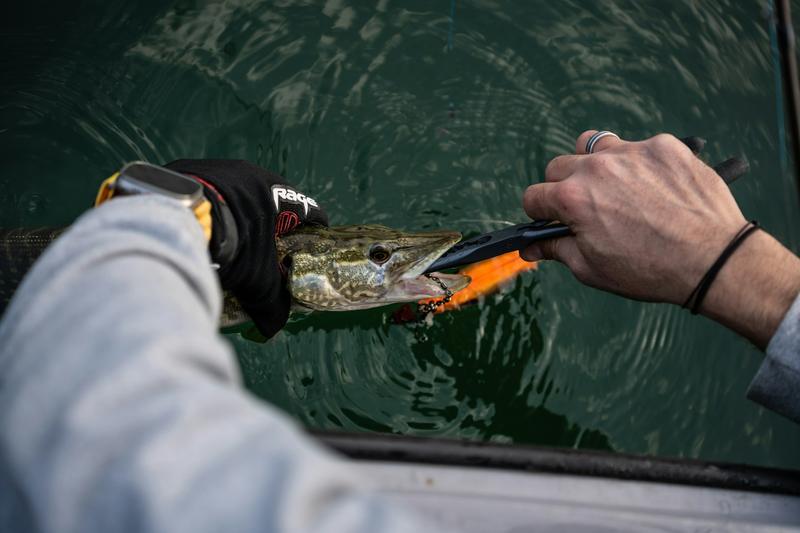
- Flip the fish gently and look under the jaw. Count the pores on one side. Six or more means musky. Five or fewer means pike.
- Look at the colors. A musky has dark marks on a light body. A pike is the reverse, with rows of light, oval spots on a dark green body.
- Check the cheek. A pike's cheek is covered in scales. A musky has scales only on the top half of its cheek.
Do this fast, and keep the fish in or near the water. A quick count and a photo are all you need.
Quick ID chart
| Clue | Musky | Tiger musky | Northern pike |
|---|---|---|---|
| Body pattern | Dark bars or spots on a light body, or none | Bold, wavy dark bars on a light body | Light spots on a dark body |
| Tail lobes | More pointed | Rounded | Rounded |
| Pores under each side of jaw | 6 or more | Varies | 5 or fewer |
| Can it reproduce? | Yes | No | Yes |
Where do tiger musky and musky live in New York?
Tigers live where DEC puts them. Most are in inland lakes and rivers in central and northern New York. See DEC's page on musky, pike, tiger musky, and pickerel fishing (opens in a new tab) for the list.
True musky have a few strongholds. DEC lists the St. Lawrence River and its major tributaries, plus the Niagara River and Buffalo Harbor, as waters with naturally reproducing musky. Chautauqua Lake supplies the eggs for the state's musky stocking program.
Northern pike live in many New York waters, including the St. Lawrence. They're one of the main fish on a regular Thousand Islands charter. Learn more in our St. Lawrence fish guide.
Are St. Lawrence River musky purebred?
Yes. The musky in the St. Lawrence are wild fish from a population that reproduces on its own. The river isn't on DEC's list of tiger musky waters. So if you hook a big, barred fish on a musky trip out of Alexandria Bay, you're almost surely looking at a true muskellunge. Read more about them on our musky page.
The St. Lawrence has a long history as musky water. Fall is the prime time to chase them. Our article on fall musky fishing on the St. Lawrence explains what a guided trip is like.
What are the rules for tiger musky and musky?
The rules depend on where you fish. As of the 2026 regulations:
- On the St. Lawrence River (NY side), musky and tiger musky share one rule. The season runs June 15 through December 15, the minimum size is 54 inches, and the limit is 1 a day.
- Statewide, for tiger musky, the season runs May 1 through March 15, the minimum size is 30 inches, and the limit is 1 a day. Some waters, like Otisco Lake, have their own rules.
- Statewide, for musky, the season runs June 1 through November 30, with a 40-inch minimum and a limit of 1.
Rules change, so check the current NYSDEC regulations for the St. Lawrence (opens in a new tab) before you go. Anyone 16 or older needs a New York fishing license.
On a Laurentian Tours musky charter, the fishing is all trolling, and almost every musky goes back in the water.
Frequently asked questions
Is a tiger musky a real species?
No. A tiger musky is a hybrid of a muskellunge and a northern pike. It can't reproduce, so the tigers in New York come from stocking.
What is the fastest way to tell a tiger musky from a musky?
Look at the tail. A tiger musky has rounded tail lobes like a pike. A true musky's tail lobes are more pointed.
How do you tell a musky from a pike?
Count the pores under one side of the lower jaw. A musky has 6 or more, and a pike has 5 or fewer.
Are there tiger musky in the St. Lawrence River?
The St. Lawrence isn't one of the waters DEC stocks with tigers. The river is known for wild, naturally reproducing musky.
Can I keep a tiger musky?
It depends on the water. Statewide, the minimum is 30 inches, but on the St. Lawrence it's 54 inches. Check the current NYSDEC regulations.
Ready to plan a musky trip? See the trip details and prices, or call or text Captain Richard at 315-836-5798.